
Tantra Begins with How We Meet Life
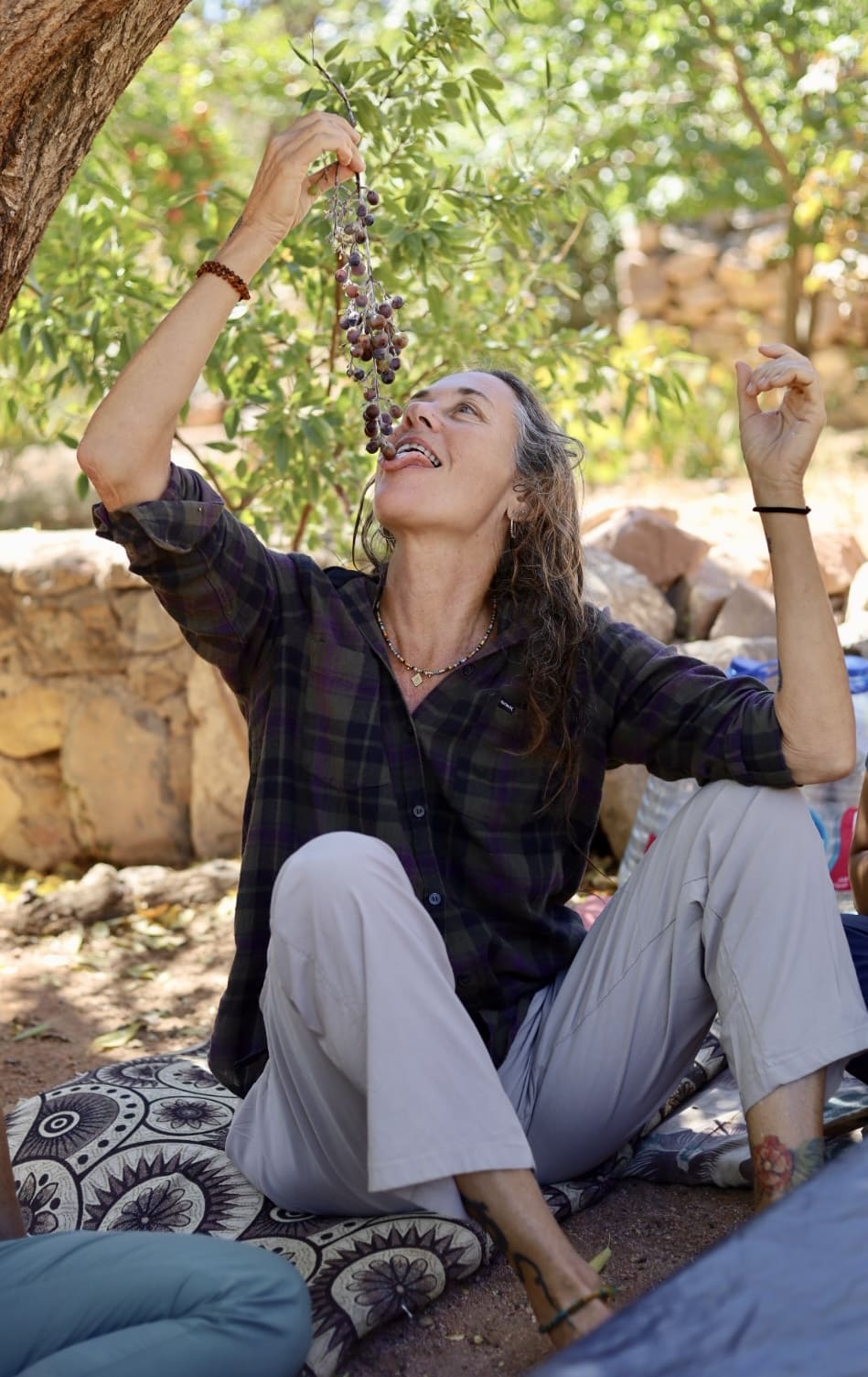
In the photo, I practice tantra with a cluster of grapes I picked in an orchard in Sinai.
Yeah, with grapes.
Because tantra doesn't start in the bedroom. It begins with the way I meet life, through my body. In my ability to be present, to feel, to listen and to discover depth even within a simple, everyday experience.
A cluster of grapes can be something you eat unwittingly while your mind is already busy with the next thing. And it can be an invitation to stop: to feel its weight in the palm of your hand, to observe the color, to taste, to pay attention to what is happening in your mouth and body.
The grapes are the same grapes. What changes is how I meet them.
So what exactly is Tantra?
When I say I teach Tantra, people often think first of sexuality. Sometimes they also think of nudity, touch or an intimate encounter between two people.
Sexuality can definitely be part of the way. But to understand its place within it, it is worth getting to know the bigger picture.
Tantra is the name given to a rich and diverse family of spiritual traditions that developed in India within Hindu and Buddhist settings, and spread to Tibet, China and elsewhere in Asia. There is no single Tantric teaching on which all traditions agree, and no single practice that defines them all.
The approach I describe here draws especially on the nondual Tantra of Kashmir Shaivism, and on the way I study, practise and bring it into my life.
One of the deepest invitations I find in this way is to meet the body and the world as part of the spiritual journey. We are here, in this life, with a body that feels, breathes, moves and changes. This body can be a gateway to a deep familiarity with ourselves and reality.
The Body as Part of the Spiritual Path
You can read a lot about presence, unity and inner freedom. You can understand complex ideas and explain them well. Still, there's a difference between understanding something in thought and experiencing it.
I can know that slowing down would help, yet keep rushing when there is no reason to. I can talk about listening, yet only realise afterwards that I have ignored my tiredness, a desire or a boundary.
Through my body I meet this gap directly.
I notice the breath that stops, the shoulders that shrink, the movement that wants to happen. Sometimes I find out how much effort I put in unnecessarily. Sometimes I find myself rushing to move on when something pleasant opens up.
Practice allows me to stay a little longer with what is here. To feel before explaining. To listen before responding.
For me, this is where the connection between the body and the spirit begins: when understanding is expressed in the way I live.
What does it mean to "meet God"?
In the post from which this article was born, I wrote that the tantric way teaches us, through the body, to meet God.
It's a big word, and each and every one has a different relationship with it. You could call it consciousness, divinity, the source of life or the deep reality of which we are a part.
In nondual Kashmir Shaivism, all of reality is understood as an expression of one consciousness, called Shiva. Shakti is the power of that consciousness to manifest, create and take the countless forms of life. Shiva and Shakti are two inseparable aspects of the same reality.
It can sound very abstract. But the meaning I find in this is close to life: if everything is an expression of the same reality, my body belongs to it, too. The breath, the senses, the emotions and the thoughts.
This opens up the possibility of seeking holiness even within the familiar life. The taste of fruit, the encounter with a person, the moment of silence, the sense of vitality that runs through the body.
I do not have to experience anything extraordinary. Sometimes, paying close attention to something simple allows me to feel part of something larger than my personal story.
How can a bunch of grapes become a practice?
Eating grapes does not automatically become a Tantric practice. Nor is enjoying something the whole of the path.
What interests me is the quality of the meeting.
Am I really tasting, or already reaching for the next grape? Can I let the feeling develop, without rushing to define it? Do I allow myself to enjoy? What happens when I stop?
Sometimes pleasure is revealed. Sometimes impatience. Sometimes I notice how difficult it is for me to be in a moment where there is no task to complete.
All of these can become material for practice. I learn about the way I meet life: where I am open, where I contract, when I am present and when I act out of habit.
This way a simple sensory experience can open up a deeper familiarity with myself.
The practice continues even when the meditation is over.
Meditation, yoga, breathing and learning have a significant place in my path. Writing and reading also accompany my observation and help me process what I encounter.
The time I devote to practice gradually affects the rest of my day. I begin to notice things that previously passed under the radar: how I eat, listen, work, rest or respond to someone close to me.
I can fold laundry and feel the fabric between my fingers. Sweep the house and pay attention to movement and breathing. Walk on the beach and feel the encounter between your feet and the sand.
No need to turn any action into a ritual. It is possible to return to the experience itself, even in the middle of a normal day.
And of course, I'm still distracted. Still rushing, forgetting and thinking. Noticing this is also part of the practice. Every time I notice, it opens up the possibility of coming back.
Meeting what feels less pleasant, too
Life includes pleasure and beauty, as well as sadness, anger, fear and uncertainty.
In my view, a spiritual path should be able to meet all of these. There is value in being able to listen to a feeling I don't want to feel, and to find out what it asks of me.
Sometimes listening leads to breathing and staying with an experience. Sometimes it leads to rest, setting a boundary, asking for help or making a practical change in life.
Recognizing that I am part of something bigger does not eliminate my personal needs. It can deepen my attitude to them, and to the needs of those in front of me.
As the practice deepens, I seek to bring more presence to these places as well. Be attentive to what is happening to me, and choose how to act.
And sexuality? It is part of life, too
When you understand this context, you can also understand the place of sexuality in the way I teach.
Sexuality is part of the human experience. It touches the body, pleasure, closeness, vulnerability, desire and boundaries. It can bring us together with love and vitality, and also with the habits and fears we carry with us.
It can therefore be a significant space for the practice of presence and listening.
What am I feeling now? What do I want? Can I express it? Am I listening to the person in front of me? Is there room to pause, to change and to choose?
From this approach, intimacy may deepen. There is more room to feel what is happening, and less need to reach for a particular experience or to live up to the expectation.
And you can walk a tantric path even without a partner or sexual practice. Life itself offers plenty of opportunities to meet the body, expand listening and deepen presence.
Return to life, again and again
As I delve deeper into the Tantra path, I discover how much depth there is in moments that once seemed obvious to me.
Breath. Movement. Meeting. Taste.
The repetitive practice allows me to recognize patterns, gradually let go of old grips and feel more freedom to be who I am. That freedom takes on meaning in the small choices of everyday life, in the way I treat myself and the way I meet others.
So when I say I'm practicing tantra with a cluster of grapes I picked in an orchard in Sinai, I mean it.
It's a simple moment of encounter with life, through the body.
In this moment there is a whole world.
If this path intrigues you, I invite you to continue reading here on the website and get to know the sessions and workshops in which I teach and accompany the connection between body, mind and intimacy.
 EN
 HE
Leave a Reply